How Motorway’s app is designed to get you the best price

By Harry Jones, Co-Founder, Motorway
When you sell your car on Motorway, you get an average of £1,600 more than you’d be offered in part exchange. More than one million people have already used Motorway to help sell their car, and 84% beat the market price. These aren’t marketing numbers — they’re the direct result of our intense focus on our vehicle profiling experience.
Profiling — the process of describing and photographing your car so that dealers can evaluate and bid on it — is the most important thing a seller does on Motorway. Get it right and you have a rich, trusted car profile that compels 8,000+ verified dealers to compete hard for your car. Get it wrong and you have a weak profile that undermines dealer confidence, suppresses bids, and creates the conditions for price renegotiation at your doorstep. The gap between those two outcomes is hundreds, sometimes thousands, of pounds.
Everything we’ve built in our app — every design decision, every piece of AI, every counter-intuitive constraint — exists to push sellers towards the first outcome, not the second.
The problem nobody talks about
There’s a common narrative in the consumer technology industry that the best product is the easiest product. The one with the fewest steps, the lowest friction, the fastest path to completion. This is often true. But it can be dangerously wrong when the experience you’re designing has a financial outcome at its core.
Selling your car is not the same as booking a hotel or ordering a takeaway. A dealer bidding tens of thousands of pounds on a vehicle they can only evaluate through a screen is making a significant financial commitment based entirely on the quality and honesty of what you’ve shown them. If the information they receive is ambiguous, incomplete, or untrustworthy, the rational thing for them to do is hedge. They bid lower, because they’re pricing in uncertainty. Or they show up on your driveway looking for reasons to justify a lower price than the one they won the auction with — something the industry calls “chipping.”
The profiling experience, done right, eliminates the conditions for chipping to exist. Done wrong, it invites it.
Some alternatives in this space have optimised for the wrong thing. They’ve built experiences that feel easy upfront — allowing sellers to upload existing photos from their camera roll, skipping steps, reducing data collection — and called it better UX. But the experience that feels easier at the listing stage routinely creates a worse outcome at the doorstep. The dealer arrives with room to argue. The photo taken six months ago doesn’t match the scuff that appeared last week. The seller doesn’t have evidence. And the price changes.
We made a different choice. We designed for the outcome, not the impression of ease.
A native app built for one job
Motorway’s apps are a fully native experiences for iOS and Android — built from the ground up for the specific demands of vehicle profiling, not adapted from a web experience.
This matters more than it might seem. The camera is the heart of the profiling process. To get the best possible results from it, you need to go deep into the platform: native camera APIs, device sensor access, real-time image analysis, precise tap-to-focus and lens selection controls. You can’t do that well in a hybrid web wrapper. You can approximate it, but approximation isn’t good enough when the quality of photos directly affects how much money a seller gets.
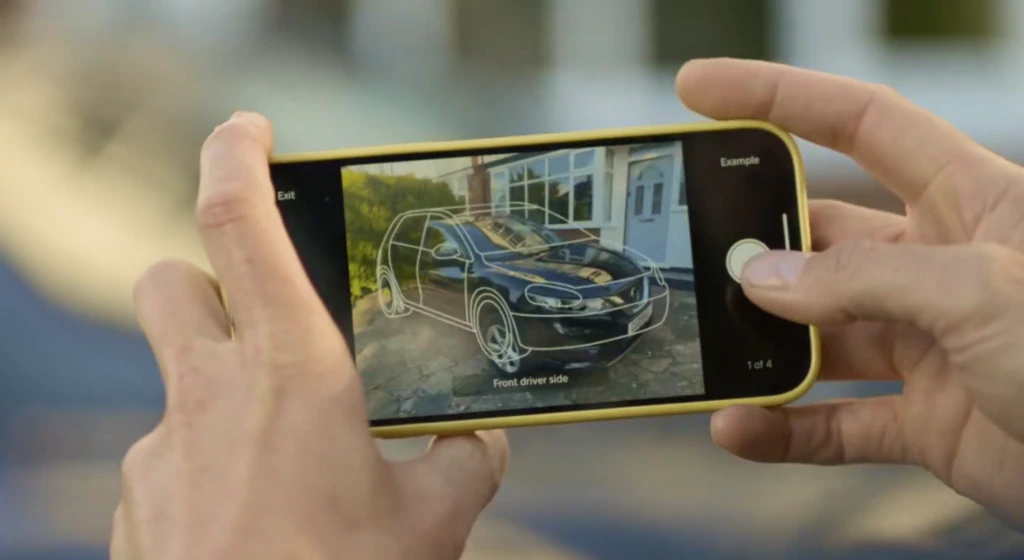
For example, on iPhone, our app integrates with the Camera Control button introduced on iPhone 16 — the dedicated hardware shutter control on the side of the device. Sellers can use it to capture photos in the guided flow, exactly as they would with a professional camera, without taking their eye off the composition. We support tap-to-focus, lens selection (wide angle for tight spaces, telephoto for capturing small scratches and dents), and exposure control. The app is fast, fluid, and built to stay out of the way.
These are not features added for the sake of a feature list. They are the direct result of understanding that a seller standing in a driveway, in variable light, holding their phone with one hand, trying to get a level shot of an alloy wheel, needs every bit of help the hardware can offer.
Personalisation: The app knows your car
A detail that might surprise people who haven’t used our app: the profiling experience is different for every car, because it’s been designed to be.
Take electric vehicles. An EV seller is asked about charging cables — whether they’re included, their condition, whether they’re the original manufacturer cables. That’s information a dealer buying an EV specifically needs to commit to a price. It doesn’t appear in a petrol car’s profile, because it doesn’t need to. The principle behind this is simple: you’re only ever asked what we need to know. No irrelevant questions, no exhaustive lists to wade through.
Vehicle features are pre-populated and personalised based on what we know is fitted to that specific variant. Sellers confirm or correct what’s there, rather than selecting from an exhaustive list of every possible option. The service history section adapts based on the vehicle’s age and known history. The photo set adjusts to the body type — a two-seater sports car won’t be asked for rear-seat photos it doesn’t have; a van won’t be asked to show a boot.
Personal circumstances are handled with the same intelligence. Sellers with a private plate can manage its retention within the flow. Finance is handled in a dedicated section that guides sellers through obtaining a settlement figure and uploading the relevant documentation. Sellers acting on behalf of a third party — such a family member — have a different flow that reflects their situation. These aren’t edge cases we’ve bolted on. They’re part of the core experience, because our sellers are real people in real situations.
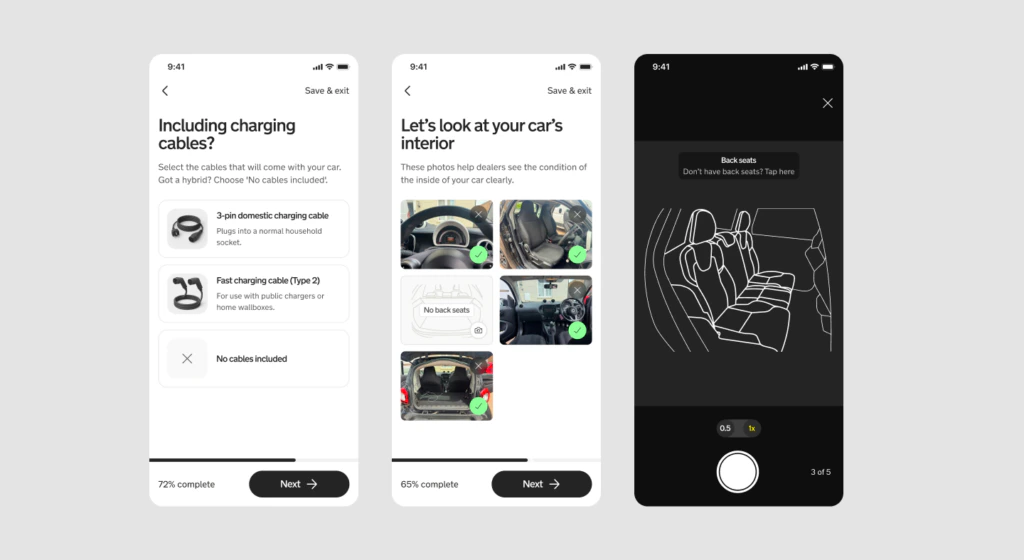
Image Assist: The AI that coaches you in real time
The most significant innovation in our profiling app is something we call Image Assist — and it represents, to our knowledge, an industry first.
When a seller takes a photo inside the Motorway app, the image is immediately uploaded to our AI platform running the cloud, which analyses it against a detailed set of requirements before passing a result back to the app. This happens in seconds. If the photo passes, the seller sees a green checkmark and moves on. If it doesn’t, the app provides a specific, plain-English coaching tip explaining exactly what to improve: tilt the phone slightly, move further back to capture the full wheel, stand in the right position, bring more light to the dashboard.
The requirements Image Assist checks against are not generic. They were developed directly with our dealer network — representing what professional car buyers need to see to bid with confidence. Some of them are highly specific. On an exterior shot, Image Assist checks that the car is fully within the frame and that the angle matches the graphical overlay on screen. On an interior dashboard shot, it verifies that the steering wheel is visible. On a rear seat shot, it confirms that the seat upholstery is in frame. These aren’t aesthetic preferences. They are the specific things dealers want to see before they’ll commit to a price.
The green checkmark is a small thing. But for a seller standing in a driveway, it’s the moment the app tells them they’ve done it right — and that feeling matters.
The business impact of this feature has been measurable and significant. In a single month, Image Assist prevented nearly 100,000 image resubmissions — instances where a seller would have submitted a photo that didn’t meet the standard, had to be told so, and had to retake it. That’s nearly 100,000 moments of friction removed from the post-submission process, and nearly 100,000 photos that dealers received at the quality they needed, first time.

Behind the scenes, Image Assist sits within a broader AI infrastructure that Motorway has built across the profiling journey. We use AI to process service history documents — extracting structured data from invoices, logbooks, and handwritten stamps with 94.7% accuracy, outperforming every other model we benchmarked. The output is a clean, structured service history record that gives bidding dealers confidence in what they’re buying. These AI capabilities aren’t add-ons. They are the product.
Live Photos: The hard decision that gets results
The most discussed aspect of our profiling app — the decision that provokes the most debate — is our requirement for live photos.
When a seller uses the Motorway app, they cannot upload photos from their camera roll. They must take new photos, in real time, through the app. Every shot is captured live, timestamped, and tied to the device that took it.
On the surface, this sounds like friction. And in the narrowest sense, it is: it takes a little longer than simply uploading photos you already have. But this decision is one of the most important things we’ve ever done for our sellers, and I want to explain exactly why.
A used car listing is, fundamentally, an act of trust. A dealer bidding £15,000 on a car they’ve never touched is trusting that what they see on screen is what they’ll find at the doorstep. If there is any possibility that the photos are old, edited, artificially enhanced, or don’t reflect the current state of the car, that trust is compromised. And compromised trust means lower bids — because rational buyers price in the risk.
Live photos, taken through the app, establish three things that no upload from a camera roll can:
Authenticity. The photo was taken today, of this car, as it currently looks. There’s no possibility of AI-generated images, no photos taken before a recent scratch, no professional shots from before the car was in its current condition. What the dealer sees is what the dealer gets.
Standardisation. Our app uses graphical overlays to guide sellers to the exact angles and compositions our dealer network has specified. Every car profile on Motorway has the same photo set, taken from the same positions, to the same standard. This means dealers develop fluency with our listings — they know exactly where to look for the information they need, and they can bid faster and more confidently as a result.
Protection for the seller. This is the one most people don’t immediately think about. Because every photo is timestamped and taken through the app, the seller has a verifiable record of the car’s condition at the time of listing. If a dealer arrives and tries to dispute a scratch, the seller has photographic evidence, taken at a known time, that the scratch was visible and disclosed. The ground for price renegotiation is removed before it exists.
The data supports this. Sellers who use Motorway get an average of £1,600 more than they’d be offered in part exchange, based on a survey of 589 sellers — a significantly larger and more robust sample than the 106 customers surveyed by the nearest equivalent platform, which reports an average uplift of £1,040. The difference is partly scale, partly network, and partly the trust that high-quality, verified car profiles create among the dealers who bid on them.
Designing for trust
Everything described above — the native app, the personalised profiling, the real-time AI, the live photo requirement — is in service of a single goal: creating a vehicle profile that dealers trust completely.
This trust is the mechanism by which sellers get more money. When a dealer opens a Motorway car profile, they know what they’re looking at. They know the photos are current. They know the overlays helped them produce standardised angles. They know AI Image Assist checked each photo for quality and composition. They know the service history was processed and verified. They know the seller’s declared damage is documented with timestamped evidence.
That knowledge removes uncertainty. And in a bidding environment, removed uncertainty translates directly into higher bids. Dealers can bid to the full value of what they see, because they have confidence that what they see is accurate.
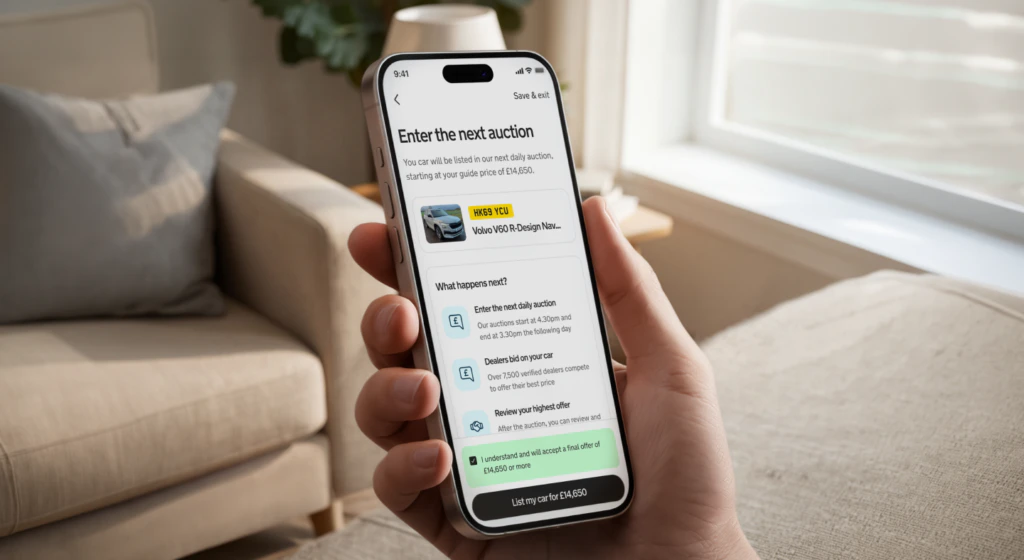
This is why we measure ourselves against outcomes. The metric we care about is the final price achieved, compared to what the seller was offered elsewhere. Not how quickly a seller can complete the listing. Not how few taps it takes to get to the submit button. Those things matter, and we work hard on them too. But they are means to an end, not the end itself.
Sellers on Motorway currently leave reviews on Trustpilot at a rate that has taken us past 100,000 verified reviews. The ones that resonate most with our team aren’t the ones that say the app was quick. They’re the ones that say:
“The taking of photos was a little fiddly but ensured that the car was described accurately.”
“Really user-friendly app that walked you through each step of the sale process.”
“Great service — if you take the time to take good, accurate photos, it gives the best chance of getting the best price.”
“Wow. What a slick process. After the initial effort of taking a few photos, everything was so easy. Within a day of finalising my advert my car was in a live auction.”
The “initial effort” is the point. The effort produces the outcome.
What’s next
We’re not finished. The profiling experience is a product, and products evolve.
Image Assist continues to improve as the model is trained on more data and new dealer requirements are incorporated. We are exploring how the personalisation layer can go further — not just adapting to the vehicle, but adapting to the seller’s context, confidence level, and the specific characteristics of the market at the moment they’re listing.
The AI infrastructure we’ve built for service history processing, image analysis, and pricing is not isolated to any single feature. It runs throughout the platform, and it’s getting more capable. We have indexed our entire technical roadmap around the belief that better AI produces better vehicle profiles, and better profiles produce better outcomes for sellers.
The goal has never changed: we want every person who sells a car on Motorway to get the best possible price, with the minimum possible friction, and the maximum possible confidence that the price they agree is the price they’ll receive.
That’s what the profiling experience is for. And it’s what we’ll keep building towards.
Motorway sellers receive on average £1,600 more than part-exchange offers, based on a customer survey of 589 sellers conducted in August 2024 who had received a part-exchange valuation at the time of selling. Individual results vary. Full methodology available at motorway.co.uk/claims.
The information provided on this page is for general informational purposes only and should not be considered as professional advice.